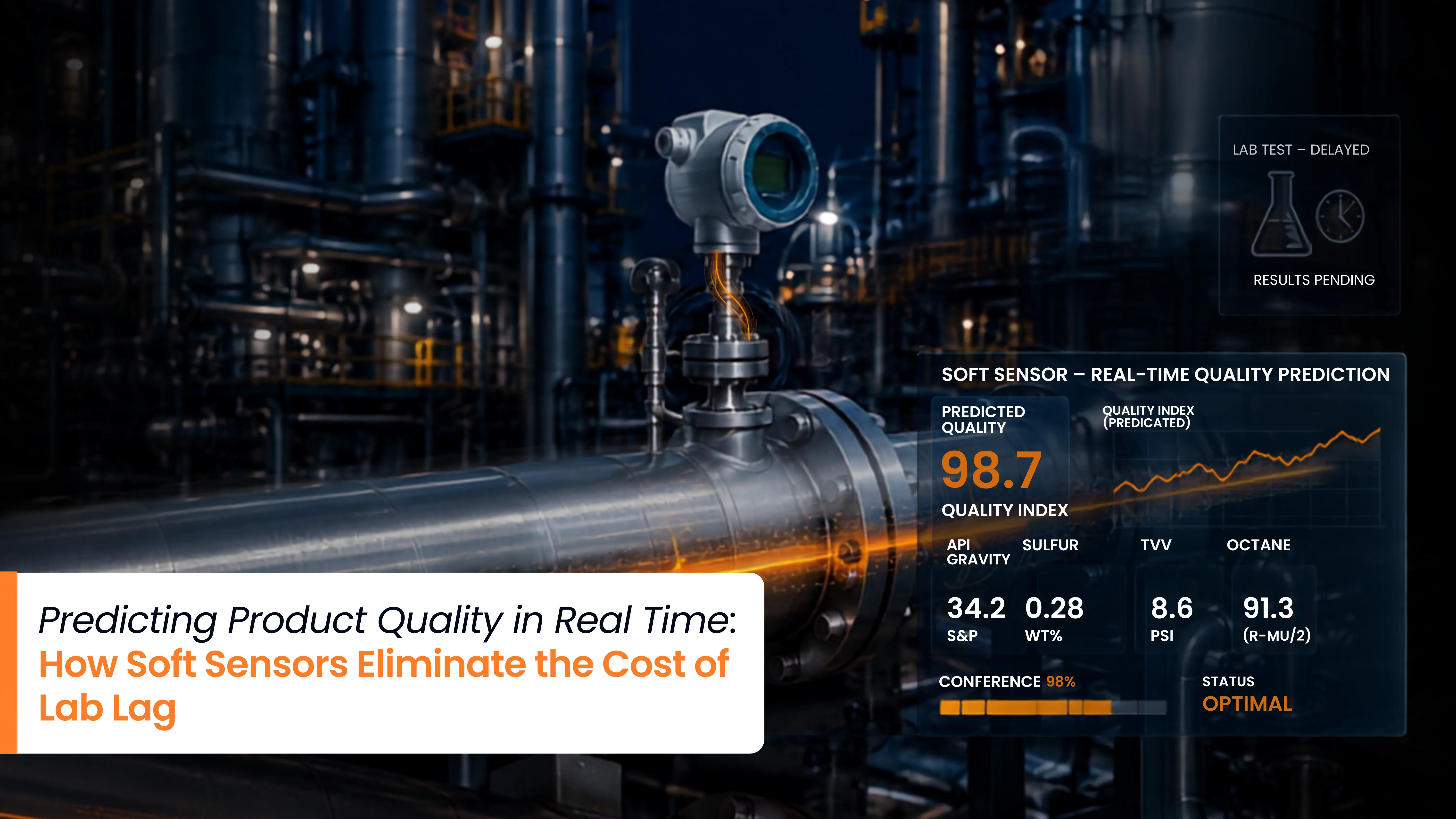
Ask any plant operator what keeps them up at night, and lab delays are near the top of the list. A batch finishes, a sample goes to the lab for testing, and the result doesn’t come back for an hour, sometimes longer. In that window, the process keeps running. If something drifted off-spec early on, nobody finds out until the product is already made and by then, the fix is a cleanup, not a correction. This is the blind spot soft sensor technology exists to close.
What Is a Soft Sensor?
A soft sensor isn’t hardware, it’s a software model that uses process data like flow, pressure, and temperature, plus machine learning, to estimate a hard-to-measure variable (like product composition) from variables that are easy to measure. As experts at Ingenero explain, this gives continuous, real-time estimations without adding a single new instrument; the spend goes into analytics, not hardware. A 2026 review in Industrial & Engineering Chemistry Research confirms how far soft sensor technology has spread, with soft sensors now delivering cost-effective predictions across oil refineries, chemical plants, pharmaceutical facilities, thermal power plants, cement kilns, and wastewater treatment alike.
The Pain Point Is the Same Everywhere: You Wait for the Lab
The molecule changes across industries, but the pain point doesn’t. In chemicals and petrochemicals, off-spec runs and product transitions are costly because composition can only be confirmed after the fact. In refining, distillation cut points and blend properties are slow and costly to sample directly. In pharmaceuticals and bioprocessing, purity and reaction-rate tracking compete with strict batch-release timelines.
Additionally, in some spots, direct sampling is dangerous, for example: a conversion point at a VCM furnace outlet, where HCl exposure rules out hardware installation. Through our work in oil & gas, petrochemical, and refining, we’ve established that this pattern keeps repeating across geographies.
Hybrid Models: First Principles Meets AI/Machine Learning
The most reliable soft sensors aren’t purely data-driven. Pure Machine Learning models are cheap to build but extrapolate poorly outside their training data. Pure first-principles models are interpretable but too rigid for drifting plant conditions. Hybrid modeling, a first-principles (physics- and chemistry-based) model paired with an ML layer that captures what the physics can’t, is the direction the field keeps moving. The April 2026 Ind. Eng. Chem. Res. review notes soft sensor development increasingly transfers both data-level and mechanistic knowledge across related processes, rather than training a purely data-driven model from scratch on each new unit.
This is the architecture behind Ingenero’s process improvement consulting deployments. At a petrochemical long-chain-alcohols facility in Louisiana, a digital twin (first-principles model) paired with an LP model and machine learning delivered a 30% capacity gain without capital expenditure, an 11% first-pass quality improvement, and roughly $300,000 in annual savings. At a site in Jubail, KSA, the same approach sustained near-100% utilization and over $75 million in savings between 2011 and 2019.
Ingenero’s I-SSPDE software packages this hybrid approach into a deployable platform pulling data from SQL, Excel, DCS/SCADA, or plant historians, running expert-validated real-time analysis, and alerting before quality drifts off-spec.
Why This Matters for AI in the Energy Industry
Soft sensors are one concrete entry point into a broader shift. Artificial intelligence in oil and gas industry deployments are moving past pilots into measurable impact- furnace optimization, yield recovery, energy reduction, and predictive maintenance are all being reshaped by AI in energy industry applications built around real process constraints, not generic dashboards.
The 2026 Global Energy Talent Index, an annual survey of over 9,000 energy professionals across 143 countries, puts a number on the gap left to close: only around 45% of oil and gas professionals currently use AI in their work, a sharp rise from 2024 but still behind other sectors. Soft sensors are a low-friction way to close that gap – quality visibility on infrastructure a plant already has, scaling naturally into the closed-loop optimization driving digital transformation in oil and gas industry operations.
The Future and Where to Start
As plants generate more historian data and computing costs fall, hybrid soft sensors will extend from single-quality prediction into full digital-twin-driven optimization, closing the loop between prediction and automated control. If lab-testing delays or off-spec batches are costing your operation time and margin, Ingenero’s process improvement consulting team can assess where a soft sensor fits your process and build it around your existing instrumentation.
Talk to Ingenero’s experts to scope a soft sensor for your plant.
FAQs
1. What is soft sensor technology?
Soft sensor technology is a software-based approach that estimates hard-to-measure process variables, like product composition or purity, from data that’s already being collected, such as flow, pressure, and temperature. It uses statistical models or machine learning instead of a physical instrument, so plants get real-time visibility without installing new hardware.
2. What industries use soft sensors?
Soft sensors are used across chemicals, petrochemicals, refining, pharmaceuticals, bioprocessing, power, and other process industries anywhere product quality is expensive or slow to measure directly. Ingenero’s use cases span oil and gas, petrochemical, and refining operations specifically.
3. What role does artificial intelligence in oil and gas industry operations play in soft sensors?
Artificial intelligence in oil and gas industry applications powers the predictive side of a soft sensor and the machine learning layer that learns patterns from plant data and estimates a hard-to-measure variable in real time. Paired with process engineering knowledge, it turns raw plant data into decision-ready predictions.
4. How can process improvement consulting help a plant get started with soft sensors?
Process improvement consulting identifies where a plant is losing time or margin to lab delays or off-spec production, then scopes a soft sensor around the data and instrumentation the plant already has. Ingenero’s team builds and validates these models with domain experts rather than deploying an off-the-shelf tool.
5. Is soft sensor technology part of digital transformation in oil and gas industry operations?
Yes. Digital transformation in oil and gas industry operations increasingly relies on unifying plant data, models, and insights into a single decision layer. Soft sensor technology is a practical entry point into that shift, since they deliver measurable value on existing infrastructure before a plant invests in larger digital twin or closed-loop optimization projects.