Industrial plants, including sectors like petrochemicals, refineries, power plants, and oil & gas, are inherently high-risk environments. Process safety assessments give these industrial facilities a structured way to understand hazards and evaluate risk.
HAZOP (Hazard and Operability Study), LOPA (Layers of Protection Analysis), QRA (Quantitative Risk Assessment), and related studies remain important throughout the asset lifecycle. They provide the engineering base for decisions around safeguards, modifications, facility design, and operations.
The challenge comes between assessments.
A facility rarely operates under exactly the same conditions year after year. A previous assessment may still provide a sound basis for the facility, but it does not continuously reflect process changes as they occur.
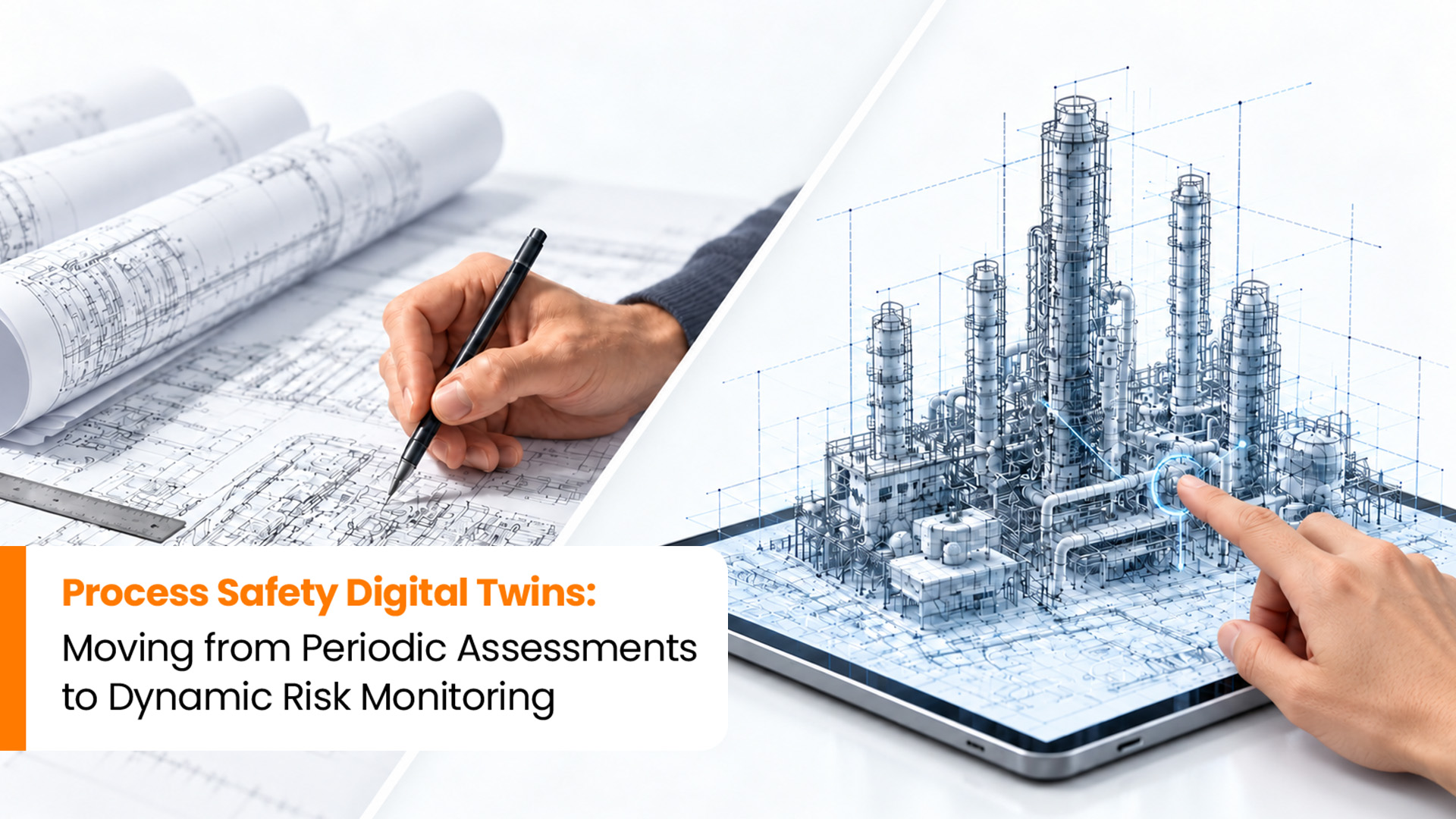
This is where a process safety digital twin can add another layer of visibility. The goal is not to replace periodic assessments. It is to make the information from those assessments more useful during day-to-day operations. Let’s understand this in detail.
The Gap Between Assessments
Consider a process unit that has undergone a detailed HAZOP and LOPA. The team has identified hazards, reviewed safeguards, and addressed the relevant recommendations.
Months later, the unit may be operating at a different throughput. Feed characteristics may have changed. A piece of equipment may no longer perform as it did when the original assessment was conducted.
None of these changes automatically means the facility has become unsafe. They do, however, create conditions that may warrant closer engineering attention.
This is one of the practical gaps that dynamic monitoring can address. Instead of relying only on the next scheduled assessment to review changes, engineers can have greater visibility into operating conditions that may influence known risk scenarios.
What a Process Safety Digital Twin Brings to the Picture
A digital twin becomes useful when it represents more than the physical asset.
For process safety applications, the digital environment can bring together relevant process conditions, equipment information, historical data, engineering models, and risk scenarios. The exact scope depends on the facility and the problem being addressed.
With digital twins, operators can simulate scenarios, test configurations or process changes without disrupting operations. Operators can even simulate dangerous scenarios to test and refine safety protocols without exposing workers to any harm. For instance, in oil & gas plants, operators can use process safety digital twin models to simulate pressure variations and detect safety gaps that may lead to leaks. Following this, preventive maintenance can be scheduled to reduce the risk of spills or explosions.
You can also monitor equipment performance in real time as the models combine sensor data and advanced analytics to continuously collect and analyse data from multiple assets. This enables you to predict failures before they happen and thus minimise unplanned downtime.
By combining AI, machine learning, IoT, and first-principles engineering, our digital twin models help you shift from reactive safety management to proactive decision-making.
From Monitoring a Deviation to Understanding Its Significance
Real-time data is useful only when you can interpret it.
Suppose pressure begins trending differently from the historical operating pattern. The change could have several explanations. It may be linked to throughput, feed conditions, equipment behaviour, control strategy, or another process variable.
Looking at one parameter alone will not explain the situation.
A digital twin can help engineers to examine the deviation on the 3D model, alongside process conditions, equipment behaviour, historical trends, and known safeguards. This makes it easier to decide whether the change is routine operational variation or something that requires further assessment.
This visual context is particularly relevant in complex facilities where process units and safeguards are closely interconnected. The objective is not to automate the safety decision. It is to give the people making that decision better contextual data.
When Does Dynamic Risk Monitoring Make Sense?
Not every facility needs the same level of digitalisation.
A dynamic approach may be worth considering where operations involve complex process interactions, large volumes of plant data, frequent operating changes, or critical safeguards that need closer visibility.
It can also be relevant for brownfield facilities undergoing modifications. A change to one part of a process can affect conditions elsewhere, particularly when equipment, controls, and protection layers are interconnected. In such situations, the question is not whether digital technology should replace established process safety practices. It is whether existing engineering knowledge can be made more accessible during ongoing operations.
In fact, one key safety benefit of a digital twin model is data consolidation. Operators no longer have to check multiple datasets to understand an asset’s status. This further reduces the gap between periodic study information and the facility’s actual physical condition.
Dynamic risk assessments using digital twins also reduce the risk of outdated information, which in turn reduces errors during modifications, maintenance or inspections. Industrial AI agents further make access to documents, equipment details, and drawings easier. Digital twins help to connect and structure this engineered data around the asset. So teams are no longer just viewing the information but analysing connected and updated data. They can work with data and simulated models that more accurately reflect reality.
Making Digital Process Safety More Practical
Implementing digital technology in process safety requires more than connecting data sources. The underlying process, equipment, safeguards, and risk scenarios need to be understood first.
With over 80 engineers dedicated to hazard analysis, Ingenero combines engineering expertise with proven digital frameworks to deliver measurable improvements in safety and reliability.
Over the past decades, we have invested more than 3 million man-hours in analysing processing facilities worldwide, covering 100k+ relief devices across 100 refineries and petrochemical sites. Through this experience, our process safety consultants can help establish the engineering context, while our digital and analytics capabilities can connect that knowledge with operational information.
This combination supports a more practical approach to digital transformation in the oil and gas industry. Instead of treating process safety digital twins as a separate technology initiative, we build it around the engineering questions that matter to the facility.
Moving Toward More Dynamic Process Safety
The real opportunity is not simply to integrate advanced digital technology into process safety. It is to make established safety knowledge more useful during ongoing operations.
Periodic assessments provide the foundation. Dynamic monitoring adds visibility between those assessments. A process safety digital twin can connect the two, bringing together plant data, engineering models, and risk information when conditions change.
For complex industrial facilities, that connection can make the difference between simply knowing what the risks are and staying closer to how those risks may evolve.
Looking to strengthen your approach to digital process safety? Talk to our experts today.