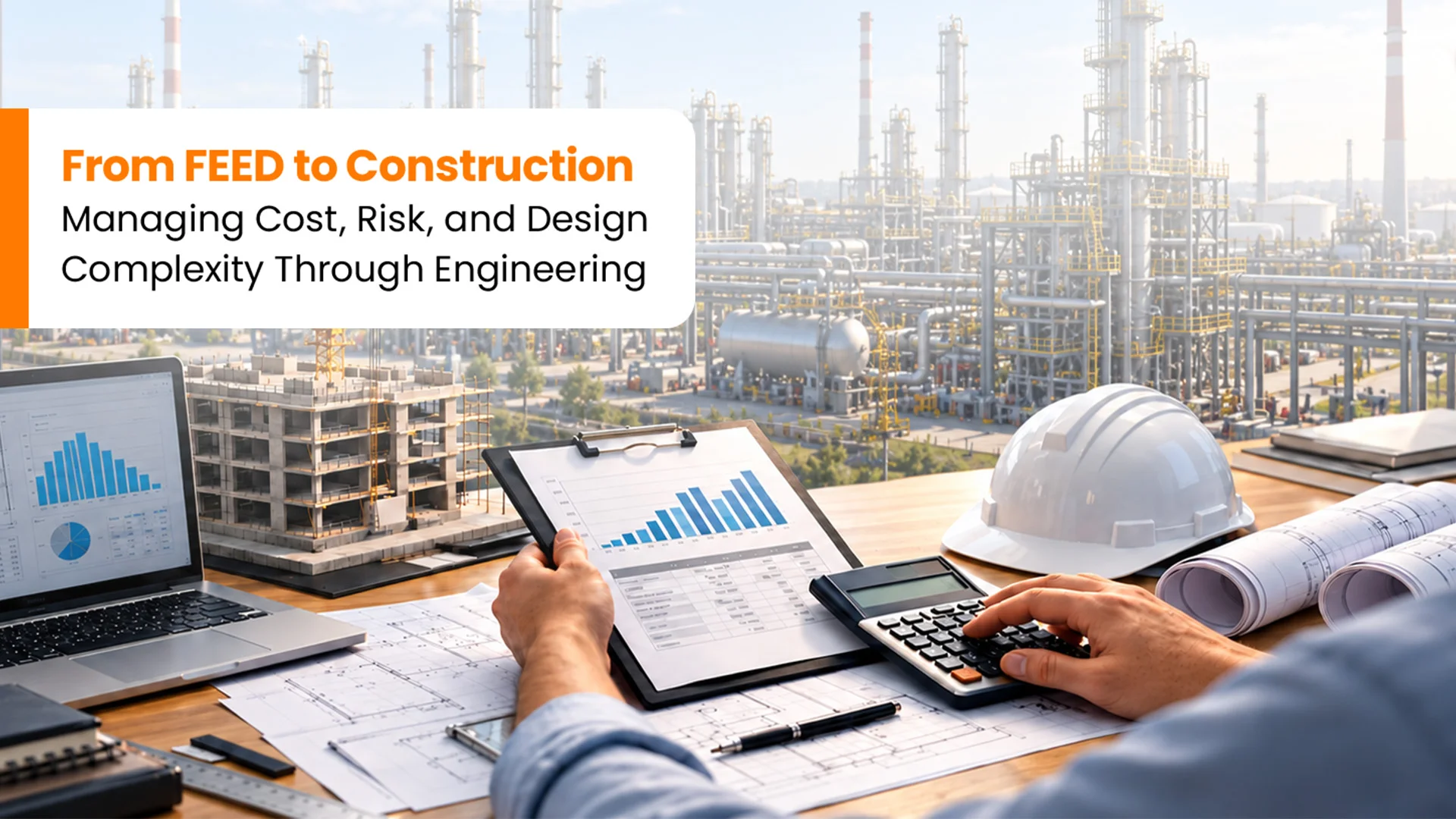
A project can look financially sound on paper and still become expensive during execution.
A change in equipment selection. An overlooked tie-in. An incomplete process definition. A late clash between disciplines. Each may appear manageable in isolation. Together, they can lead to rework, procurement delays, schedule extensions, and rising project costs.
This is why the engineering work done before construction deserves more attention.
Front-End Engineering Design (FEED) and detailed engineering have different roles, but they are closely connected. FEED establishes the technical and commercial foundation. Detailed engineering turns that foundation into construction-ready information. A strong early-stage approach can reduce the number of expensive decisions left unresolved later.
What Does Front-End Engineering Design Establish?
Front-End Engineering Design sits between the initial concept and detailed engineering. Its purpose is to establish what the project needs to achieve and how it should be taken forward.
During FEED, teams typically work on:
- Defining the project scope and design basis
- Developing process requirements and preliminary layouts
- Identifying major equipment and technical specifications
- Coordinating different engineering disciplines
- Assessing technical and project risks
- Developing cost estimates and project schedules
- Establishing procurement and execution requirements
Ingenero’s FEED services establish project-specific technical requirements, develop the system design foundation, support budget approval, and contribute to risk mitigation.
The value is not simply in producing documents. It is in resolving important questions while the project still has room to change.
Where Detailed Engineering Takes Over
Once the project scope and technical basis are sufficiently established, detailed engineering takes the work to a much greater level of precision.
This is where preliminary decisions are developed into the information required for procurement, construction, installation, and commissioning.
For example, detailed engineering may involve:
- Final equipment specifications and datasheets
- Detailed PFDs and P&IDs
- Piping layouts, isometrics, and stress analysis
- Electrical and instrumentation drawings
- Structural and foundation details
- 3D modeling and interdisciplinary clash checks
- Material take-offs and procurement documentation
- Construction-ready technical documentation
Ingenero’s detailed engineering services cover multidisciplinary engineering for both greenfield and brownfield projects, including debottlenecking. The team integrates process, mechanical, piping, electrical, instrumentation, HSE, and other disciplines into a coordinated engineering package.
We provide 3D modeling using laser-scan point cloud of existing facilities. Three-dimensional modeling helps teams examine spatial constraints and design interfaces before construction. For existing facilities, it helps engineers account for actual site conditions during brownfield modifications.
Why Early Decisions Have a Cost Impact
The cost of changing a decision usually increases as a project moves forward.
Changing a process assumption during an early study may require an engineering revision. Changing it after equipment has been specified can affect procurement. Discovering the same issue after fabrication or construction can involve physical rework, delays, and additional expenditure.
A well-developed FEED package can therefore create value before construction begins.
It can help teams identify:
- Design interfaces that need early coordination
- Long-lead equipment requirements
- Potential constructability issues
- Technical or safety risks
- Procurement implications
- Scope gaps and conflicting assumptions
- Opportunities for value engineering
The benefit extends to design coordination. Structured 3D model reviews at different stages, for example, can help teams identify clashes and resolve interface issues before they reach the construction site. It can also help evaluate design alternatives against cost, technical requirements, and execution needs.
This is one reason FEED is often treated as a risk-reduction exercise rather than simply another project phase. It gives the project team an opportunity to resolve major technical and commercial questions before detailed design and construction commitments become harder to change.
The Cost of Carrying Uncertainty Forward
Consider a brownfield expansion.
A new process unit has to connect with existing utilities, piping, electrical systems, and control infrastructure. If those interfaces are not understood early, the issue may only become obvious once detailed engineering or construction is underway.
By then, several teams may already be working from the earlier assumption.
This is where detailed feasibility reports and early engineering studies can provide useful decision support. They can help establish whether a proposed modification is technically viable, what constraints may affect it, and where additional investigation is required before committing significant capital.
Existing structures, foundations, piping routes, and electrical systems may also need adequacy checks before modifications are approved. These assessments are particularly important when an expansion or retrofit must fit within the constraints of an operating facility.
The same principle applies to greenfield developments. A decision that looks minor during concept development can affect equipment sizing, plot space, utilities, material quantities, and downstream engineering.
FEED vs. Detailed Engineering: Where Each Adds Value
| FEED | Detailed Engineering |
| Defines project scope and design basis | Develops final technical details |
| Establishes preliminary equipment requirements | Finalizes equipment specifications |
| Supports cost and schedule estimation | Produces procurement and construction documentation |
| Identifies early technical and project risks | Resolves detailed design and interface requirements |
| Supports investment and budget decisions | Supports execution, installation, and commissioning |
The two stages should therefore not be treated as competing alternatives.
FEED reduces uncertainty before detailed engineering. Detailed engineering reduces uncertainty before construction.
How Ingenero Connects the Two
The transition between stages matters as much as the work performed within each stage.
Ingenero supports clients from FEED through detailed engineering, including multidisciplinary design, feasibility studies, brownfield engineering, retrofitting, debottlenecking, 3D modeling, and specialized engineering studies.
Our capabilities also extend to procurement assistance and construction management.
This creates scope to support activities beyond design documentation, including technical bid evaluation, vendor drawing reviews, procurement scheduling, contractor coordination, and construction-stage engineering reviews.
This continuity can help preserve design intent as a project moves from early decisions to execution.
For process engineering consultants, the focus is not only on completing the next engineering package. It is also about understanding how decisions made in one stage affect the work that follows.
As experienced oil & gas engineering consultants, Ingenero can help connect process requirements with equipment, piping, electrical, instrumentation, safety, and construction considerations.
The Real Advantage Is Earlier Clarity
FEED does not eliminate every project risk. Nor does detailed engineering guarantee that execution will be free of changes.
What they can do is move important decisions to a point where they are easier and less expensive to address.
A stronger engineering basis can support better cost estimates, more coordinated design, more informed procurement, and fewer surprises during execution. For oil & gas engineering companies working on complex projects, the quality of this early decision-making can ultimately influence both project economics and schedule performance.
Ingenero combines FEED, detailed engineering, feasibility studies, and specialized engineering capabilities to support projects across their lifecycle.
Planning a new project, expansion, or debottlenecking initiative? Connect with Ingenero to discuss the engineering approach your project requires.
FAQs
1. What is the difference between Front-End Engineering Design and detailed engineering?
Front-End Engineering Design establishes the project scope, design basis, technical requirements, risks, and preliminary cost and schedule. Detailed engineering develops these decisions into precise drawings, specifications, calculations, and documentation for procurement and construction.
2. When should companies involve process engineering consultants?
Organizations can involve process engineering consultants during concept development, FEED, feasibility studies, detailed engineering, or debottlenecking. Early involvement can help identify process constraints and engineering requirements before they create downstream design issues.
3. What should companies look for in oil & gas engineering consultants?
Look for multidisciplinary experience, relevant project expertise, strong FEED and detailed engineering capabilities, and an understanding of how process, mechanical, piping, electrical, instrumentation, and safety requirements interact.
4. How can oil & gas engineering companies reduce project uncertainty?
Experienced oil & gas engineering companies can help identify technical constraints, coordinate disciplines, develop realistic cost estimates, and resolve key design questions before construction. This can reduce late-stage changes, rework, and avoidable project delays.