Industrial facilities are not static. Processes are modified, new equipment is added, production rates change, and regulations evolve. Every change could introduce new hazards or alter existing risks. The challenge isn’t deciding whether a safety study is needed. It’s determining which one will provide the insights required to make informed operational decisions.
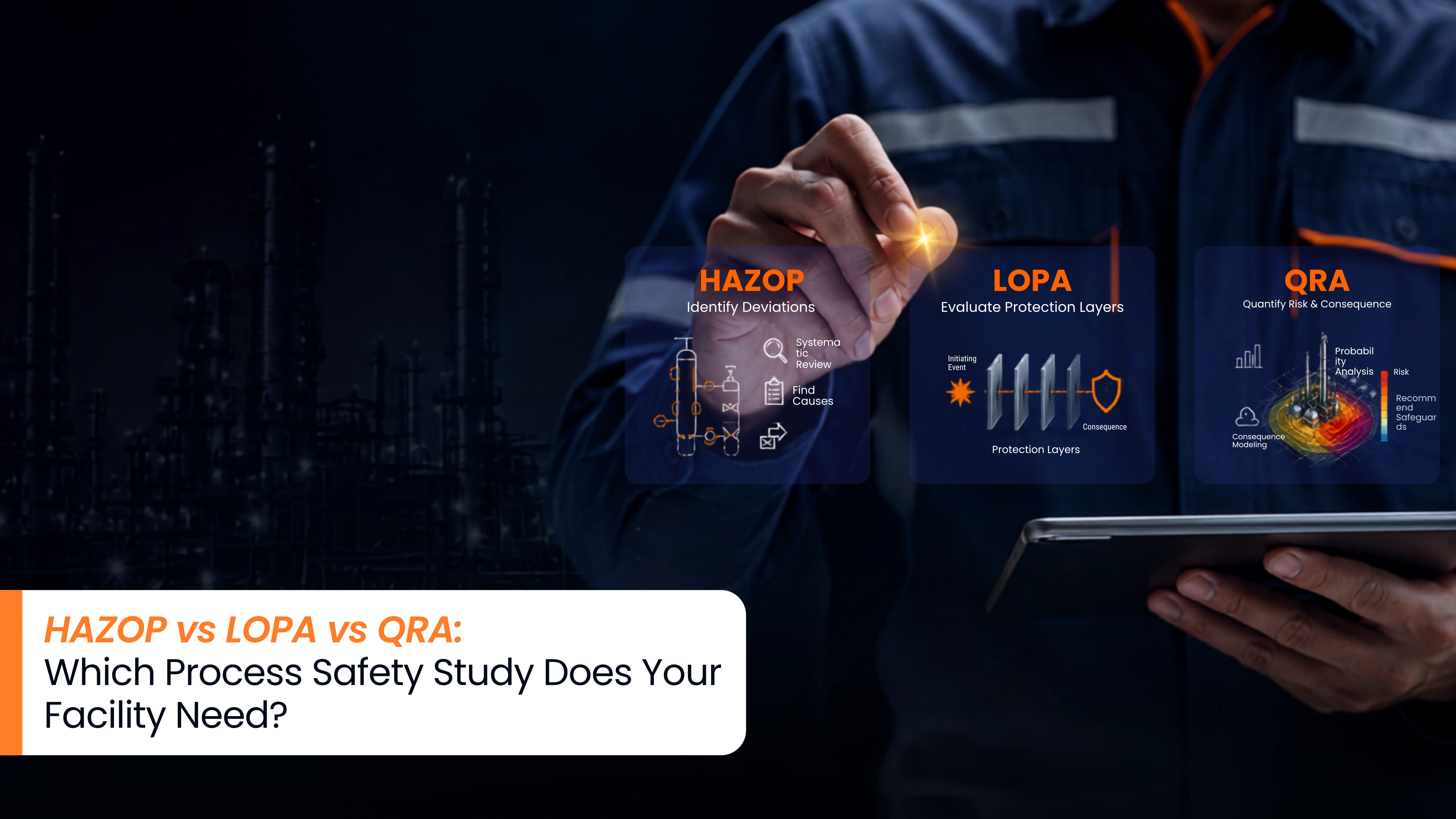
HAZOP, LOPA, and QRA are among the most widely used process safety risk assessment methodologies, but each addresses different questions.
Why One Process Safety Assessment Doesn’t Fit Every Situation
Process safety measures should be viewed as decision-making tools and not just compliance checklists. As operational challenges differ, the same assessment cannot answer every question. On top of this, selecting an incorrect or inappropriate assessment can lead to
- Implementing safeguards that don’t address the actual problem
- Wastage of time collecting unnecessary data
- Overlooking critical risks
- Delaying critical engineering or project decisions
This is why understanding the differences between HAZOP vs LOPA vs QRA and what each methodology is designed to achieve becomes essential. With this, facilities can proactively identify hazards and strengthen their safety performance. This proactive approach is especially important for process-intensive industries such as petrochemicals, oil and gas, refineries, chemical manufacturing, and pharmaceuticals, among others.
HAZOP: Identifying Process Hazards Before They Become Problems
HAZOP (Hazard and Operability Study) is a widely recognized qualitative hazard identification technique. It is conducted by process safety management consulting experts to identify potential hazards, operational issues, and opportunities for process improvement within industrial systems and facilities.
Post the analysis, the team could also recommend appropriate actions to prevent, mitigate, or control the detected hazards.
The process is based on the assumption that risk incidents are caused by deviations from design intent. This systemic technique identifies unintended outcomes to understand their impact on the safety and health of equipment as well as workers.
HAZOP is often conducted during facility design and construction to ensure that the plant performs as expected. It addresses questions such as “What can happen if the process deviates from normal conditions?”, “What will happen if temperature exceeds design limits?”, and “Could equipment failure create unsafe conditions?”.
It takes a detailed approach to identifying potential hazards by systematically examining each equipment, vessel, and pipeline, on a Piping and Instrumentation Diagram (P&ID) using specific guide words.
HAZOP adds the most value in:
- Design or modification stages of a project
- Existing operations
- Decommissioning activities
- FEED and detailed engineering
It does not produce numerical risk values and instead focuses on uncovering operational weaknesses. Once hazards are identified, organizations often need to understand whether their existing protection systems are enough. This is where LOPA becomes valuable.
LOPA: Determining Whether Existing Safeguards Are Enough
LOPA (Layer of Protection Analysis) is a semi-quantitative risk assessment tool that analyzes independent incident scenarios and compares a scenario risk estimate to its risk criteria (tolerable frequency). So, instead of focusing on hazard identification, LOPA studies emphasize independent protection layers needed to mitigate risks associated with the identified hazards.
It takes an independent incident scenario, then looks at the initiating cause frequency, subtracts the existing protection layers (relief valves, shutdown systems, or alarms), and calculates if the remaining risk meets the facility’s risk criteria. If a gap remains, a new protective layer is needed.
LOPA is also a commonly used method to determine if a facility requires SIF (Safety Instrumented Function), a critical safeguard, to bridge the safety gap. It brings the process or equipment to a safe state during specific hazards.
LOPA adds the most value in:
- Rigorous/Detailed analysis of high-risk scenarios
- Deciding if SIF is necessary
- Evaluating existing protection layers
- Safety Integrity Level (SIL) assessment
- Risk reduction planning
- Validating HAZOP recommendations
While LOPA evaluates the effectiveness of safeguards, some facilities require a deeper understanding of the likelihood and consequences of major accident scenarios. This is where QRA plays an important role.
QRA: Quantifying the Consequences of Major Risks
QRA (Quantitative Risk Assessment) is a detailed analysis used in process safety management to quantify operational risks and their probabilities.
It evaluates the level of risk to plant workers both inside and outside the facility. It takes the major hazard scenarios detected during hazard identification and studies them using numerical analysis and advanced probabilistic modelling.
The process combines failure frequencies, historical data, equipment reliability data, and consequence modelling to estimate the probability of hazardous events. It also provides information on the impact of such events.
Because QRA produces measurable outcomes, it is often used when objective evidence is needed to support regulatory compliance, facility design decisions, or long-term safety planning.
QRA adds the most value in:
- Measurable risk estimates
- Planning safety investments
- Comparing different design options
- Demonstrating compliance
- Emergency preparedness planning
Which Process Safety Assessment Does Your Facility Need?
Below are a few common scenarios that may need to be addressed using one of these assessments –
If you want to:
Identify process hazards during design
- HAZOP
Check whether current safeguards reduce risk adequately
- LOPA
Understand potential consequences of major accidents
- QRA
Implementing new SIS
- LOPA
Considering these assessments as HAZOP vs LOPA vs QRA is not always an ideal approach. Because for many facilities the answer is more than one safety study. So, while each of these assessments can be done independently, they often build on one another instead of replacing each other.
Selecting the sequence depends on project stage, operational objectives, and risk profile. It provides a robust risk assessment.
For instance, if you are planning a plant expansion – HAZOP will help you identify the hazards introduced by the new equipment or process. LOPA then determines where the existing safeguards are adequate or if additional protection layers are needed. Finally, QRA can help evaluate in greater detail how the proposed expansion might influence the plant’s overall risk profile.
So, for many facilities, these methodologies are not alternatives. They are complementary assessments that together support a comprehensive process safety strategy.
Supporting Better Process Safety Decisions with Ingenero
Over the past few decades, Ingenero has supported multiple industries across the globe in ensuring safer and more reliable operations through process safety management consulting services.
Our team of engineers and chemical process engineering consultants has carried out hundreds of studies to support process reliability, operations excellence, and risk mitigation. As your reliable engineering partner, we deliver recommendations that can be implemented rather than simply documented.
Conclusion
Effective process safety begins with asking the right questions. Whether the objective is identifying hazards, validating safeguards, understanding the consequences of potential incidents, or all three, selecting the appropriate assessment enables organizations to make more informed decisions throughout the asset lifecycle.
Working with experienced process safety management consulting experts can help ensure each study delivers actionable intelligence and long-term value.