Choosing an industrial AI or engineering consulting partner is rarely a simple business decision.
A solution may look promising during a demonstration. The harder questions emerge later. For organizations exploring artificial intelligence in oil and gas industry applications, the evaluation process needs to go beyond technical features.
Several vendors may offer similar capabilities. One talks about AI agents. Another focuses on engineering services. A third presents a platform with an extensive list of features.
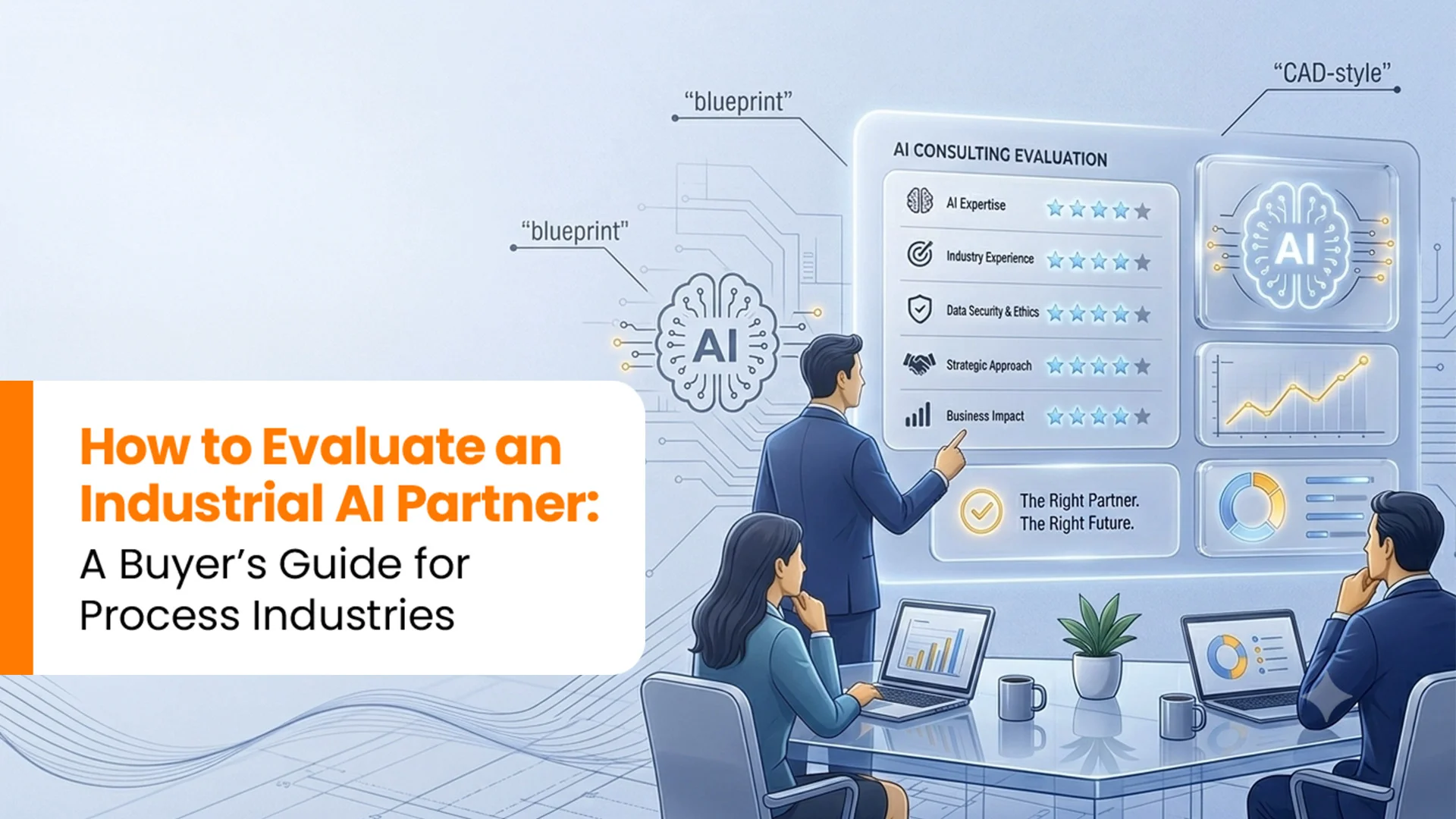
How should a process industry evaluate these options? Here are six areas worth examining before making the final decision.
1. Does the Partner Understand Your Industrial Problem?
A strong discovery process should involve more than a requirements document. It should consider plant conditions, existing workflows, available data, and the decisions the solution is expected to support.
This is where experienced process engineering consultants bring an important perspective. They can help distinguish between a problem that needs process improvement, better instrumentation, engineering analysis, or digital intervention.
2. Examine the Data Before Accepting the Promise
A demonstration often uses clean, prepared data. Actual plants rarely operate under those conditions.
Information may be distributed across historians, DCS or SCADA systems, maintenance records, engineering documents, and legacy applications. Some records may be incomplete. Certain tags may not be reliable. Access permissions can also affect what a solution is able to use.
Before appointing a partner, ask them to explain the data requirements clearly.
A practical discussion should also cover:
- Which systems will provide the required information?
- How will missing or inconsistent data be handled?
- What integration work is expected?
- Who will manage access and cybersecurity requirements?
- How will the solution be maintained when plant conditions change?
This is especially relevant when evaluating oil & gas engineering consultants for a digital project. A partner may understand the engineering problem but still need a realistic plan for working with the facility’s existing systems.
3. Can the Partner Connect AI With Engineering Knowledge?
Industrial AI operates within physical systems. Its outputs need to make sense in relation to equipment, processes, operating conditions, and safety requirements.
Consider industrial AI agents. An agent may be able to identify a deviation, bring together information from different sources, or recommend a next step. But who determines whether that recommendation is appropriate? What engineering rules guide the output? When should an issue be escalated to a specialist?
These questions matter more than a long list of automation features.
A suitable partner should be able to demonstrate experience across areas such as:
- Process engineering and optimization
- Asset performance and reliability
- Data analytics and Applied AI
- Process safety and risk
- Energy management and operations excellence
Ingenero combines these capabilities across its engineering and digital services. This allows AI and analytics applications to be considered alongside the processes and decisions they are intended to support.
4. How Will Performance and ROI Be Measured?
Avoid evaluating a partner through broad promises about efficiency or transformation.
Start with a baseline.
Depending on the use case, relevant measures could include equipment availability, downtime, maintenance costs, energy consumption, production throughput, troubleshooting time, or process variability.
Then agree on how progress will be assessed.
A partner should be able to explain:
- What will be measured?
- Over what period?
- Which teams will validate the results?
- What assumptions influence the expected outcome?
- What happens if the pilot does not meet its objectives?
The evaluation should also cover delivery ownership, milestones, reporting, and responsibilities.
5. Does the Partner Have Relevant Industrial Experience?
Experience should be assessed for relevance, not simply by the number of years in business.
An organization evaluating oil & gas engineering consultants should look for evidence of work involving comparable assets, operating conditions, engineering requirements, or business challenges.
The same applies when selecting chemical process engineering consultants. Experience in chemical manufacturing, specialty chemicals, or process safety may be more useful than a generic list of AI projects.
6. What Happens After the Pilot?
A pilot can demonstrate technical feasibility without proving long-term operational value.
Before starting, discuss what happens if the initial use case performs well.
This is especially important for industrial AI agents, where model outputs, workflows, permissions, and escalation paths may need ongoing review.
A partner should provide clarity on:
- Implementation and handover
- User adoption and training
- Model monitoring
- System maintenance
- Governance and change management
- Scaling across sites or use cases
The objective is to avoid creating a solution that works during a controlled pilot but becomes difficult to manage in day-to-day operations.
A More Practical Way to Compare Partners
Use the evaluation process to compare how each partner thinks, not only what each partner sells.
Share the same operational problem with shortlisted providers. Ask them to explain their proposed approach, required data, engineering assumptions, implementation risks, and success measures.
The differences often become clearer during this discussion.
For organizations exploring artificial intelligence in oil and gas industry applications, a partner’s ability to connect technical work with plant realities is as important as its AI capabilities. The same applies when evaluating process engineering consultants for a broader engineering and digital transformation program.
Conclusion
The right industrial AI or engineering consulting partner should bring more than a platform, a team of developers, or a collection of technical credentials.
Look for engineering understanding, relevant experience, clear accountability, practical integration planning, and a measurable approach to value.
Ingenero combines process engineering, Applied AI, advanced analytics, operations excellence, and safety expertise to support industrial organizations across complex operational challenges.
Connect with Ingenero to discuss a practical, engineering-led approach.
FAQs
1. What should companies look for in an industrial AI partner?
Evaluate the partner’s industrial experience, engineering expertise, data capabilities, integration approach, governance practices, and ability to demonstrate measurable outcomes. The partner should understand the operational problem before recommending a technology.
2. Why is engineering expertise important in industrial AI projects?
Engineering knowledge helps interpret plant data within the context of equipment, processes, operating conditions, and safety requirements. This is important when using industrial AI agents or predictive solutions to support operational decisions.
3. What should oil and gas companies ask potential consulting partners?
Companies should ask about experience with comparable assets, data integration, process safety, cybersecurity, implementation support, and post-project ownership. Relevant experience as oil & gas engineering consultants should be supported by specific project examples.
4. Can AI and engineering consulting be handled by one partner?
Yes. A combined approach can connect engineering analysis, data interpretation, Applied AI, and operational implementation. The suitability of this model depends on the project’s scope, internal capabilities, and the partner’s demonstrated expertise.