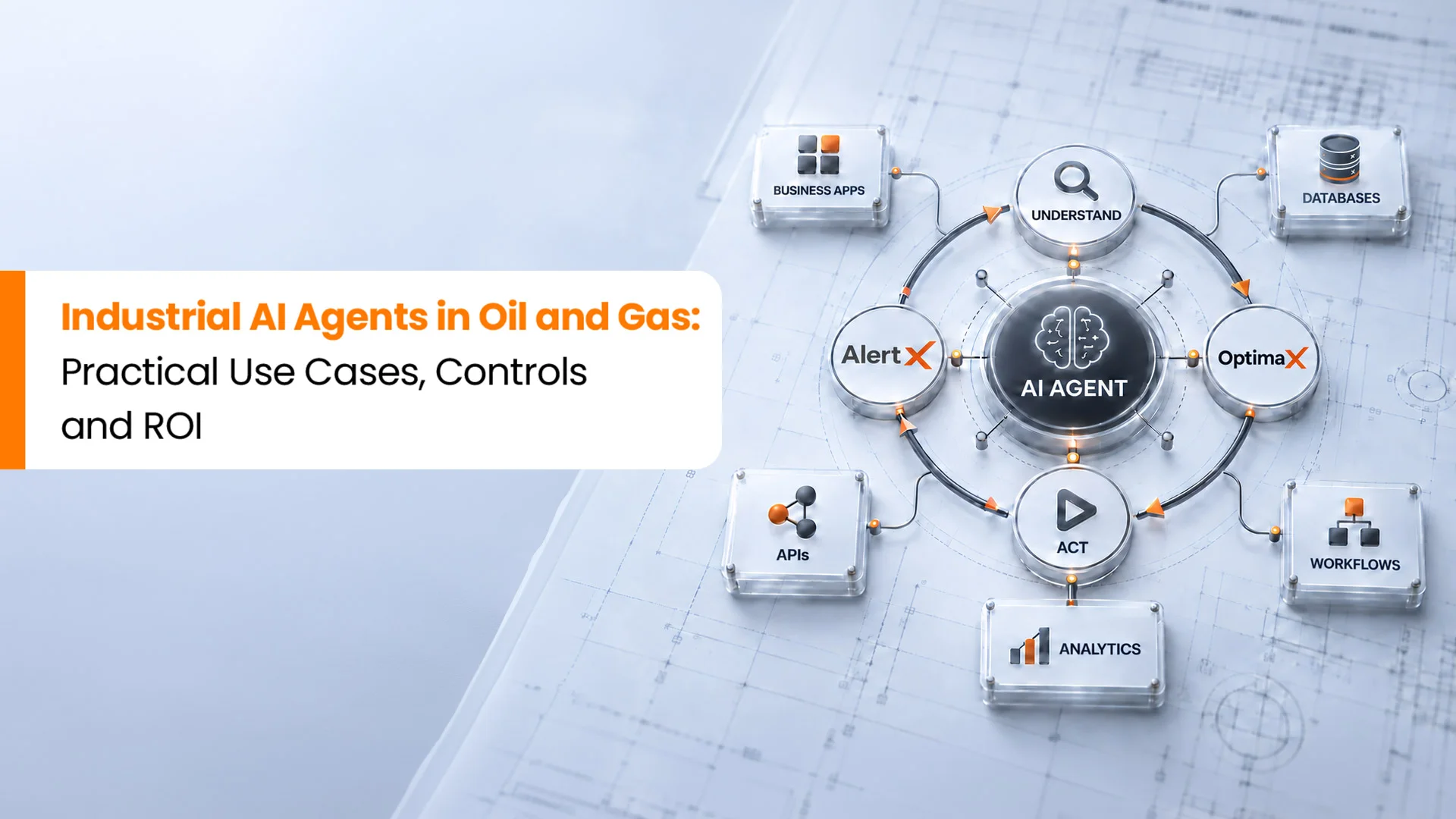
AI is already being used across oil and gas operations for monitoring, prediction, optimization, and anomaly detection. The next step is making these systems more useful in the day-to-day work of engineers and operations teams.
This is where AI agents in oil and gas can have practical value.
An industrial AI agent can monitor defined conditions, interpret information from multiple sources, and recommend actions or trigger workflows based on rules and models. The important distinction is that the agent is built around a specific operational problem. It is not simply another chatbot connected to plant data.
For process industries, that difference matters.
Where Can Industrial AI Agents Actually Help?
The strongest use cases are usually tied to decisions that teams already make repeatedly.
1. Spotting equipment and process deviations
A refinery or petrochemical plant can generate thousands of tags across compressors, heat exchangers, reactors, pumps, and other equipment. Reviewing every trend manually is time-consuming.
An industrial AI agent can watch selected variables continuously and flag behaviour that warrants attention.
This could include:
- Gradual equipment drift
- Short-duration spikes
- Unusual operating patterns
- Changes across related process variables
- Conditions associated with developing equipment problems
IngeneroX’s AlertX, for example, uses AI/ML to detect deviations across live process data and prioritizes alerts so engineers can focus on issues that matter. The system also lets process experts tune thresholds rather than relying entirely on fixed, generic alarms.
So, instead of reviewing thousands of tags manually, the team sees only what needs attention: prioritized and contextualized. This resulted in:
- 60% Fewer Unplanned Downtimes
- 70% Faster Fault Detection
- $1M+ Annual Maintenance Savings
2. Supporting operational optimization
Finding a deviation is only half the job. The next question is usually, what should we do about it?
This is where AI agents in oil and gas can move beyond monitoring. An agent can bring together current process conditions, historical behavior, equipment information, and defined operating objectives to support a recommendation.
For example, an optimization workflow may look at production, energy consumption, and operating KPIs together. OptimaX follows this approach by identifying gaps from desired operating conditions and providing engineers with guidance on process adjustments.
The recommendation still needs to make sense within the operating context. This is where human insight adds value to the process.
Where GenAI Can Support Engineers and Operators
There is a separate problem which traditional analytics does not usually solve: finding and working with information.
Engineers often need to move between operating data, equipment history, procedures, reports, and engineering knowledge while investigating a problem.
GenAI for operations can make that interaction more natural. Instead of manually searching across several systems, users could ask questions in plain language and retrieve relevant information from approved sources.
The value is less about generating impressive answers and more about reducing the time spent finding the right information.
Controls Matter as Much as Capability
An agent operating around a refinery, petrochemical plant, chemical process, or power utility cannot be given unrestricted authority simply because its model performs well.
A practical control framework should define:
- What the agent can see:
Which tags, documents, equipment records, and systems are within its scope? - What it can recommend:
Which decisions can be supported automatically, and which require engineering review? - What it can change:
For higher-risk operations, recommendations can remain advisory rather than directly altering control-system settings. - When it should escalate:
Critical deviations, low-confidence outputs, or conditions outside the defined operating envelope should move to the appropriate engineer or operator.
This human-in-the-loop approach is particularly important when artificial intelligence in oil and gas industry applications are connected to safety, production, reliability, or environmental decisions.
How Do You Measure ROI?
“AI will improve efficiency” is not a business case. So, you need to begin with a measurable problem.
For one facility, that could mean reducing unplanned downtime. For another, it may be improving throughput, reducing energy use, shortening troubleshooting time, or reducing manual monitoring effort.
A useful pilot should therefore establish:
- Baseline condition
- Operational problem being addressed
- Metric being tracked
- Expected improvement
- Time period for evaluation
Our approach is similarly built around problem-specific solutions and pilots, with success tied to direct ROI impact.
That makes the conversation much more concrete than measuring AI adoption by the number of dashboards or models deployed.
Engineering Context Behind Industrial AI
Ingenero brings process engineering knowledge together with AI, analytics, and digital capabilities. Our digital solutions are designed to work with existing plant data sources rather than requiring a complete replacement of the systems already in place.
That matters in process-intensive facilities.
A practical deployment can start with a defined problem, connecting the relevant data, establishing the decision logic, and keeping the output within the level of control the plant is comfortable with.
For industrial AI agents, that engineering context is what separates a useful operational solution from another layer of automation.
Conclusion
The value of AI agents in industrial operations will not come from making every plant decision autonomous.
It will come from helping teams notice the right things sooner, find relevant information faster, and act on recurring operational problems with better context.
For artificial intelligence in oil and gas industry applications, that means starting with the process problem, setting clear boundaries, and measuring what changes after the solution is introduced.
That is a more practical route to AI adoption: specific use case, defined controls, measurable outcome.
FAQs
1. What are AI agents in oil and gas used for?
AI agents in oil and gas can support anomaly detection, equipment monitoring, process optimization, information retrieval, and operational decision support. Their scope should be defined around a specific plant problem.
2. How are industrial AI agents different from traditional analytics?
Traditional analytics often presents trends, KPIs, or predictions for users to interpret. Industrial AI agents can take the next step by bringing relevant information together and generating a recommendation.
3. Is GenAI for operations safe to use in industrial environments?
GenAI for operations should operate within defined data, access, and approval boundaries. For safety-critical or production-critical decisions, outputs should remain subject to appropriate engineering and operational review.
4. How can AI ROI be measured in a plant?
Start with a specific baseline and a measurable operational problem. Depending on the application, this could involve downtime, throughput, energy consumption, troubleshooting time, productivity, or maintenance cost.
5. Can artificial intelligence in oil and gas industry applications work with existing plant systems?
Yes. The approach can be designed around existing historians, operational data, and other approved sources. The exact integration depends on the use case, system architecture, and plant requirements.