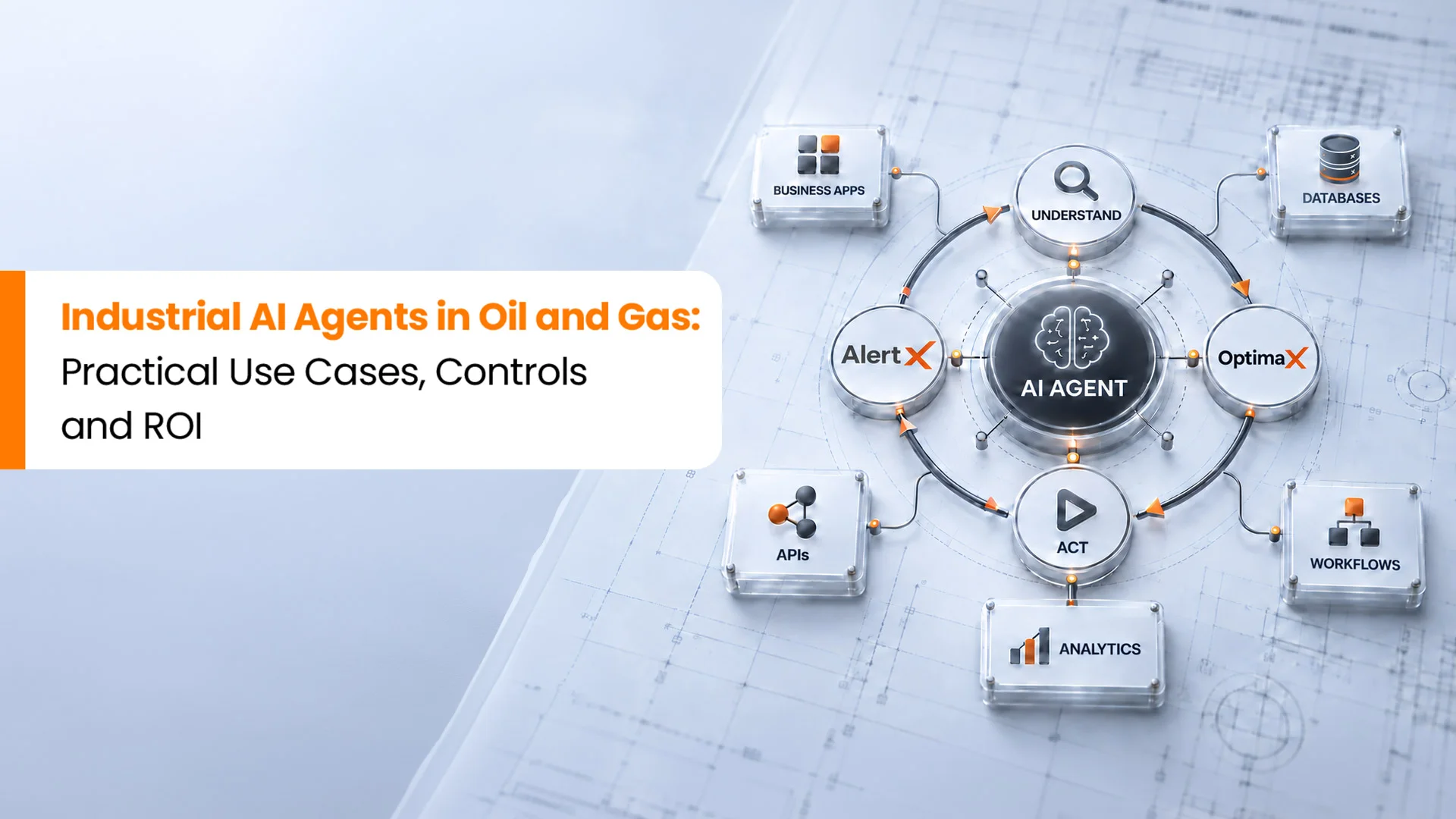
AI and machine learning models are no longer new concepts in the oil and gas industry. Most organizations have already spent years collecting data through control systems, sensors, and monitoring tools. What’s changing now is how that data is being used. Instead of just generating reports or dashboards to gauge performance, companies are increasingly using AI to make everyday decisions.
This shift is largely because of the need to improve efficiency, meet growing sustainability expectations, and manage costs. In terms of revenue, the global AI in the oil and gas market is expected to reach approximately USD 25.24 billion by 2034. Rather than implementing AI across every operation, companies are focusing on specific, high-impact problems. This mindset is why AI use cases in oil and gas are becoming more practical and visible.
Where AI is actually creating value
Advanced algorithms and data models are used to optimize exploration, production, refining, and distribution processes. These are usually areas where large amounts of data already exist, yet teams rely heavily on manual analysis and interpretation.
For example, operators often review the same parameters daily, and engineers repeatedly analyze similar performance issues. This is where machine learning energy sector applications are improving visibility into operations rather than replacing existing systems.
Oil and gas companies can integrate AI models into their existing operations to achieve quick wins through automated tasks or enable core transformation by overhauling crucial workflows. Businesses can also have greater control over production or create entirely new personalized energy-saving solutions.
For instance, an oil and gas producer in India faced the challenge of off-spec/sub-spec production, resulting in a loss of quality and profits. The company aimed to improve its capacity and quality. Our engineers at Ingenero deployed Continuous Proactive Operations Support service for Decision Excellence. We also used advanced analytics to identify the root causes of the problems and proactively suggest remedies. This led to enhanced asset availability, improved uptime and US$ 6.5 million savings for the company.
Below are some real-world data models and AI use cases in oil and gas companies across the globe.
Use Case 1: Improving Plant Performance with Analytics
Oil and gas industries generate a constant stream of data, including pressures, flow rates, and temperatures, among others. However, this data is often underutilized. Because of this, the insights are either not fully explored or delayed, leading to inefficiencies that go unnoticed.
AI and advanced analytics help by analyzing both historical and real-time data. These models identify patterns and highlight deviations or processes where performance drops. With this, the teams get a clearer picture of what is actually happening inside the plant.
In one of our projects, a petrochemical company in Louisiana, USA, was facing issues with off-spec production and multiple product transition complexities. Our team used operational advanced analytics with “Decision Insight” support on a daily basis. We deployed the analytics solution using a first-principles process model for the digital twin and LP model. We monitored real-time and historical data with machine learning techniques.
Goal:
- Capacity Improvement by10%
- Quality Improvement by 5%
We achieved:
- First Pass quality improvement by 11%
- Capacity enhancement without CAPEX by 30%
- External tolling stopped
- Annual savings US$ 300,000
Use Case 2: Digital Twins for Process Optimization
Another important digital transition is the use of digital twins for process optimization. Making changes in a live plant can be risky, as even small adjustments can affect production or quality. Because of this, teams are often cautious about experimenting.
Digital twins address this by creating a virtual version of the plant. Engineers can test different scenarios and operating conditions without affecting real operations. Machine learning further improves these models by making them more accurate using actual plant data.
This enables better decision-making and reduces trial-and-error. Teams can optimize processes, improve throughput, and plan changes with greater confidence. These kinds of solutions are becoming increasingly relevant across the oil and gas industries where operational risks are high.
By building a rigorous digital twin of the unit operations for two Ethylene facilities of a US Petrochemical major based in the Middle East, our team enabled:
- Plant data analysis through machine learning
- Continuous remote plant tracking
- Process operations insights on day-to-day basis
The result?
- Improved yield, plant availability, throughput and efficiency
- Achieved US$ 250 million savings over a 5-year period of Operations Excellence Program
Use Case 3: Improving Energy Efficiency Through Data-Led Analysis
In many oil and gas industrial plants, energy consumption tends to be higher than expected. That’s not because of one major issue but due to the continuous lack of visibility into how energy is used across the processes. Outdated systems, or in some cases, limited or incomplete data, make it even harder to identify where energy is being lost. This is where sustainability consulting services play an important role, helping organizations identify opportunities for improvement and implement them effectively.
One of our clients, a petrochemical (LAB) facility in Jubail, KSA, faced a similar challenge. The company was facing issues with data unavailability and full complex analysis. Our goal was to significantly reduce energy consumption. Our team at Ingenero worked on onsite data collection, utilities audit, data generation, simulation, and Pinch analysis using customized models, process analysis and whatifs to address this issue. Through these solutions, we:
- Reduced the inherent need of heating/cooling for the process
- Achieved benefits of up to US$ 7,000,000
- Improved efficient usage of utilities
What makes these use cases actually work
While the use cases sound straightforward, their success depends on a few key factors. Technology alone is not enough. One of the biggest challenges is data. Many organizations still deal with fragmented or inconsistent data across systems.
For AI to work effectively, data needs to be clean, structured, and accessible. There also needs to be a clear understanding of the process itself. This is why combining analytics with engineering knowledge is important. We help you in bridging this gap. With over 500 applied AI solutions use cases, we at Ingenero provide customized AI and data-led solutions, focusing on not just implementing them but aligning the tools with your actual operational needs.
Conclusion
The oil and gas industries are grounded in the physical world, not the virtual one. However, digital solutions are slowly turning them into AI-first companies as the processes transform from “AI-assisted” to “AI-driven” sustainable operations.As one of the leading sustainability consulting services, Ingenero has helped companies achieve more than 25% reduction in emissions and over 12% savings in energy usage. Looking at real world AI examples energy companies have applied, it is evident that combining AI with domain expertise leads to tangible results. Over time, these incremental improvements add up, making operations more efficient, reliable, and sustainable.
FAQ:-
1. What are the most impactful AI use cases in oil and gas operations?
The most impactful use cases include plant performance optimization, predictive maintenance, digital twins for process simulation, energy optimization, and production quality improvement. These applications focus on high-value areas where large volumes of operational data already exist and can deliver measurable gains in efficiency, cost savings, and reliability.
2. How does AI improve plant performance and efficiency?
AI analyzes real-time and historical data such as pressure, temperature, and flow rates to identify patterns and detect inefficiencies. It highlights deviations, recommends corrective actions, and enables proactive monitoring, helping teams improve throughput, reduce downtime, and enhance overall plant performance.
3. What role do digital twins play in process optimization?
Digital twins create virtual replicas of physical plants, allowing engineers to simulate different operating scenarios without impacting real operations. This reduces risk, minimizes trial-and-error, and enables better planning, leading to improved throughput, yield, and operational efficiency.
4. How can AI help reduce off-spec production in refineries and petrochemical plants?
AI continuously monitors key process parameters and identifies deviations that may lead to off-spec production. By detecting issues early and recommending adjustments, it helps maintain consistent quality, reduces waste, and improves first-pass yield.
5. In what ways does machine learning enhance decision-making in oil and gas?
Machine learning models process large datasets to uncover hidden patterns and trends that are difficult to detect manually. These insights support faster, data-driven decisions, reduce reliance on manual analysis, and help engineers respond more effectively to operational challenges.